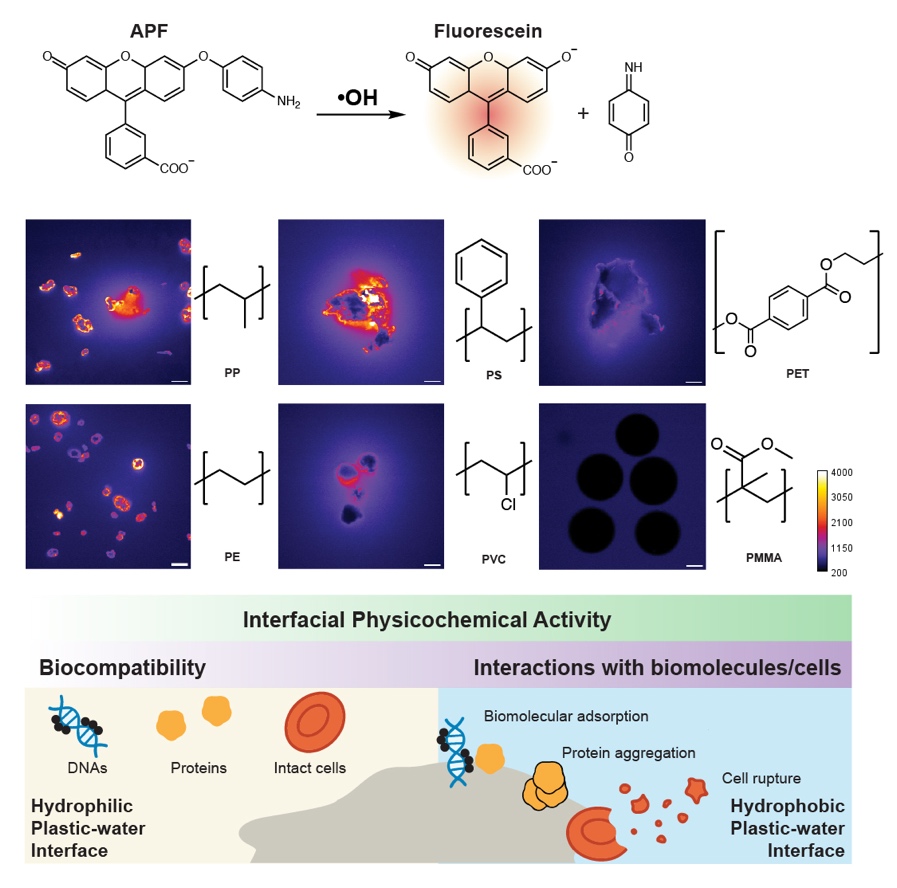
Plastics are conventionally regarded as chemically inert materials because of their stable polymer backbones. However, fragmentation into microplastics and nanoplastics dramatically increases their surface-area-to-volume ratio, making interfacial chemistry increasingly important. We discovered that plastic–water interfaces can spontaneously generate reactive oxygen species, even without conventional external triggers such as sunlight or added catalysts. This intrinsic activity depends strongly on polymer hydrophobicity and correlates with interfacial electrostatic properties, revealing a previously overlooked connection between polymer surface chemistry, interfacial water, and radical generation. The resulting chemical activity can influence interactions with biomolecules and cells, providing a potential molecular mechanism linking microplastic exposure to oxidative stress and biological effects. Beyond its environmental and biomedical implications, this discovery establishes plastic–water interfaces as a model system for studying how seemingly inert materials can acquire unexpected chemical reactivity through interactions with water.
- N. Qian, R. Zhao, K. C. Chan, V. Vuong, X. Gao, Z. Zhao, R. A. LaCour, Y. Dai, P. Stapleton, B. Yan, T. Head-Gordon and W. Min. “Intrinsic physicochemical activity at microplastic–water interfaces,” Nature 658, 650–657 (2026).